When Governance, Trust and Transparency Collapsed
1. The Core of the Dispute
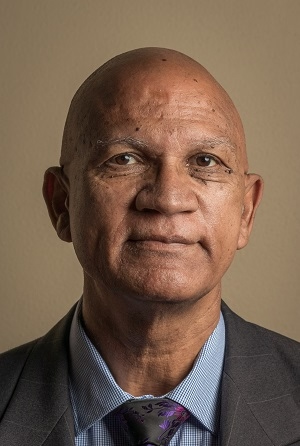
When Colin Puren was appointed as the Municipal Manager by the Mossel Bay Local Municipality, the Council authorized Executive Mayor Dirk Kotzé to negotiate his total remuneration package. Puren was placed on the maximum allowable salary scale, which amounted to R1,538,800 annually.
However, both the Western Cape MEC for Local Government (Anton Bredell) and the national COGTA Minister (Dr Nkosazana Dlamini-Zuma) had issued explicit directives stating that Puren should only be remunerated on the minimum scale of R1,160,847 annually.
2. The Whistleblower & The Cover-Up Allegations
The issue exploded into the public domain after a former Democratic Alliance (DA) councillor, Anco Barker, blew the whistle. Opposition parties—including the Freedom Front Plus (FF Plus) and the African Christian Democratic Party (ACDP)—discovered that Mayor Kotzé had withheld the ministers’ letters from the broader council during the salary approval votes.
Because the critical, legally binding directives from the provincial and national government were kept hidden, the council was misled into approving the inflated package. This led opposition parties to file formal criminal charges of fraud and corruption against the DA caucus with the Hawks.
3. “Pay Back the Money” Resolution
Following intense legal scrutiny, a legal opinion from Coetsee Van Zyl Attorneys, and massive political pressure, the DA-led council executed a major U-turn. In a special council meeting, an urgent motion revoked Puren’s maximum salary scale.
· The Repayment Sum: Puren was ordered to pay back exactly R573,805.75.
· The Timeline: The structured repayment period spans from 30 September 2023 until 28 February 2027, coinciding with the official end of his contract term.
4. Divided Public Response
The saga triggered strong, opposing viewpoints within the Garden Route region:
· The Opposition View: Opposition Parties condemned the lack of transparency, calling it a flagrant abuse of ratepayers’ money to protect a political appointment.
· The DA & Supporter Defense: High-profile DA leaders (including Cape Town Mayor Geordin Hill-Lewis) defended Puren’s performance, arguing that Mossel Bay is consistently recognized as one of South Africa’s best-run municipalities. They claimed that keeping elite, uncorrupted administrative
talent requires maximum-tier compensation, and that uniform national pay caps handicap high-performing towns.
The Mossel Bay Local Municipality resolved the legal deadlock over Colin Puren’s salary by bypassing the initial restrictions through a formal ministerial bypass known as a COGTA waiver application.
The step-by-step strategy utilized to legally secure the top-tier pay package includes:
1. Bypassing the Regulations via Section 56
Under the Local Government: Municipal Systems Act, a municipality can apply directly to the national Cooperative Governance and Traditional Affairs (COGTA) Minister for a remuneration waiver. This legal mechanism permits a high-performing municipality to pay its senior management above the standard government-gazetted limits if it fulfills distinct operational and financial criteria.
2. Capitalising on Political Shift and Clean Audits
The original 2023 pay caps were strictly enforced by the previous COGTA Minister, Dr Nkosazana Dlamini-Zuma. Following the formation of national government transitions, the municipality re-submitted its waiver motivation to the newly appointed COGTA Minister, Velenkosini Hlabisa.
The municipality successfully argued that:
· Mossel Bay possesses the affordability and structural availability of funds within its active budget to pay the higher tier without impacting service delivery.
· The town’s exceptional track record of 11 clean audits over 12 years justified the maximum remuneration scale to retain top administrative skill.
3. Ministerial Overturn and Council Approval
Minister Hlabisa formally reviewed and overturned the prior salary limitations. He issued an official executive directive granting the waiver, authorizing Puren to be remunerated at the maximum scale for a Category 4 Municipality.
On 12 September 2024, the Mossel Bay Council convened a Special Open Council Meeting and formally voted to implement the amended ministerial waiver with immediate effect, aligning Puren’s contract back to the upper salary limits until its expiration on 28 February 2027.
The Local Reaction
The successful COGTA bypass triggered heavily conflicting local responses:
· The DA and Ratepayers Association Supporters: Celebrated the move as a major victory for local government autonomy. They asserted that paying market-related rates prevents skilled administrators from fleeing well-run Western Cape towns.
· Opposition Parties (FF Plus and ACDP): Criticized the maneuver as a political cover-up. They noted that while the waiver made the future salary legal, it did
not erase the ethical fallout or the ongoing Hawks investigations regarding the initial hidden documentation.
The ultimate resolution of Colin Puren’s salary through a ministerial COGTA waiver left a deeply fractured legacy in Mossel Bay, creating sharp divisions over governance principles. The systemic impacts on compliance, honesty, and ratepayer prejudice depend on whether the situation is viewed through a legalistic lens or an ethical one.
1. The Impact on Honesty and Transparency The saga initially dealt a severe blow to public trust and political honesty: [1]
· The Precedent of Non-Disclosure: Executive Mayor Dirk Kotzé deliberately withheld binding letters from provincial and national ministers during the initial council vote. This established a troubling precedent: a ruling majority could manipulate democratic council processes by hiding unfavourable legal directives.
· Whistleblower Vulnerability: The truth only surfaced because an internal DA councillor, Anco Barker, resigned in protest to expose the cover-up. This highlighted a local political culture where internal party loyalty was prioritized over transparent public reporting.
· Subsequent Compliance vs. Initial Deception: While obtaining the COGTA waiver eventually made the salary legal on paper, it did not retroactively erase the initial dishonesty. Critics argue that using a political transition to overturn a prior infraction demonstrates that structural loopholes can easily bypass transparency failures.
2. The Impact on Legislative Compliance
The long-term effects on compliance are contradictory, functioning as both a failure and a reinforcement of statutory frameworks:
· Exposure of Regulatory Gaps: The saga demonstrated that national salary caps under the Municipal Systems Act can be easily undermined or bypassed if a municipality has enough political leverage to secure an executive waiver.
· Forced Accountability: Conversely, the framework did force compliance when exposed. The fact that the municipality had to execute a U-turn, pass an urgent council motion, and implement a R573,805.75 clawback agreement proves that legislative checks and opposition-driven pressure can successfully halt unauthorized spending.
· Continuing Criminal Cloud: The subsequent COGTA waiver does not legally nullify the ongoing Hawks Serious Commercial Crime investigation. The act of fraud was committed the moment council was misled; a later administrative override does not automatically absolve past criminal liability.
3. The Impact on Ratepayer Prejudice
The financial and social impact on Mossel Bay’s residents created two intensely opposing arguments:
· The Exploitation Narrative: Opposition groups argue that ratepayer prejudice was undeniable. Public funds were utilized unlawfully to inflate a senior official’s lifestyle, and the structured repayment plan essentially acted as an interest-free loan funded by the community.
· The “Value for Money” Argument: Proponents—including regional business groups and DA leadership, strongly counter that the real prejudice to ratepayers would be appointing an incompetent, lower-tier manager. They argue that under Puren’s administration, Mossel Bay remained one of South Africa’s safest, cleanest, and most stable municipalities. From this perspective, paying a market-related premium secures billions in infrastructure assets, offering ratepayers a strong return on investment
• The Lasting Trust Impact: Regardless of which side of the debate residents support, the matter fundamentally altered how many ratepayers now view municipal governance and political accountability in Mossel Bay. For many, the issue was never merely about salary levels, but about honesty, transparency, and the moral obligations attached to public office. The perception that material information may have been withheld during a critical public decision created a lasting sense that ethical boundaries had been compromised in pursuit of a desired outcome. Even where later legal mechanisms
regularised the remuneration position, many residents remain of the view that the original conduct reflected a serious failure of governance morality and public trust, one that prejudiced not only ratepayers financially, but also the credibility and integrity of the municipality itself.