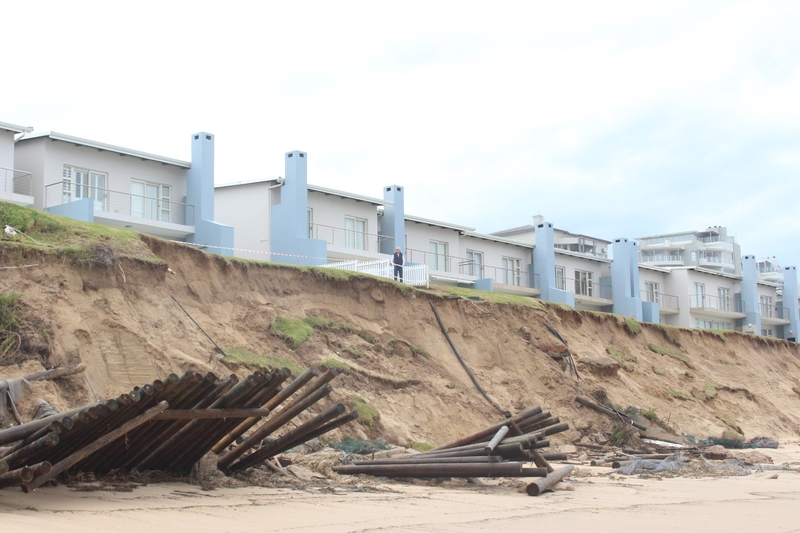
The recent Western Cape High Court judgment in Coetzee NO and Another v Mosselbay Municipality exposes a deep, structural vulnerability within the Mossel Bay Municipality [The Western Cape High Court judgment in Coetzee NO and Another v Mosselbay Municipality exposes a deep, structural vulnerability within the Mossel Bay Municipality]. What began as a highly contentious process to alienate prime public land has ended in a damning judicial rebuke.
This issue is not about political ideology, party lines, or factional battles. It is strictly a matter of statutory compliance, administrative law, and fiduciary duty. The case serves as a textbook example of how a failure to adhere to mandatory legislative frameworks inevitably results in costly legal defeats, leaving local ratepayers to carry the financial burden.
1. The Failure of Competitive Procurement Frameworks
The structural breakdown of Erf 6393 began with a departure from standard, competitive municipal asset management protocols. Under the Local Government: Municipal Finance Management Act (MFMA) and the Asset Transfer Regulations, the disposal of high-value public land requires rigorous open market exposure to ensure fair market value and equal opportunity.
In this instance, the Municipal Council approved a direct, closed transaction for a 4,800 m² beachfront erf for R980,000, bypassing a competitive public tender process. Because the beneficiary trust was represented by a close relative of a sitting councillor, the need for strict compliance with open tender frameworks was magnified. Even though the individual councillor formally recused himself from the vote to avoid a direct conflict of interest, the administration’s failure to implement an open competitive process created an immediate institutional vulnerability.
2. Administrative Panic vs. Statutory Process
The subsequent legal defeat was born directly out of administrative panic when the public and local oversight groups objected to the closed sale. Faced with mounting community pressure, the Council voted on 29 February 2024 to summarily rescind its original “in-principle” approval.
However, an administrative body cannot simply undo a formal resolution by a casual show of hands. By reacting to public pressure rather than strictly following administrative law, the Council completely bypassed its legal obligations. The administration rushed to cancel the agreement without navigating the statutory protocols required to formally rescind an active municipal decision.
3. Unsupervised Legal Oversights and Procedural Arrogance
Any junior municipal compliance officer or legal practitioner knows that public bodies cannot arbitrarily strip a contracting party of an “in-principle” right without a fair hearing. Yet, the municipality’s internal legal apparatus permitted this procedurally flawed cancellation to proceed directly to the High Court.
This reveals a profound lack of independent oversight and gatekeeping within the municipality’s legal division. Rather than advising the Council against an unlawful, knee-jerk administrative choice, the legal team aggressively defended it in court. By attempting to validate a cancellation that explicitly violated Section 3(2)(b)(ii) of the Promotion of Administrative Justice Act (PAJA), the legal team demonstrated a stubborn, costly insistence on defending an indefensible procedural error.
4. Profound Prejudice to Process and Ratepayers
By bypassing the audi alteram partem (hear the other side) principle in its rush to nullify the deal, the municipality severely prejudiced the entire administrative framework. The High Court was left with no choice but to set aside the Council’s cancellation and remit the matter straight back to the municipality, effectively resetting the clock and wasting months of public time.
The ultimate casualties of this legal mismanagement are the ratepayers of Mossel Bay. The High Court ordered the town to pay the applicant’s legal costs on Scale C—the highest scale of legal fee recovery permitted under the High Court tariff system.
These unbudgeted, punitive legal costs are now being drained directly from municipal coffers. Hard-earned money paid by local property owners is actively being used to cover the costs of a legal crisis engineered by an administration that chose rapid, non-compliant shortcuts over sound, legally sound administrative procedures.
Call to Action: Stand Up for Accountability
The Dana Baai Erf 6393 debacle is a stark warning. Mossel Bay Municipality cannot continue to treat expensive High Court litigation as a financial buffer for flawed, non-compliant administrative choices. When municipal structures fail to enforce strict competitive tenders and lawful procedures, local ratepayers are the ones who pick up the tab.
We cannot stop this systemic legal bungling alone. We need a united front to demand strict statutory compliance, competitive procurement, and absolute financial responsibility from our local administration.
Get involved and support the movement:
· Visit the Mossel Bay Ratepayers Association Website to join our network and protect your town.
· Sign up to receive direct alerts on upcoming municipal property alienations and administrative notices.
· Help us hold the Council accountable before your tax money is squandered on the next avoidable courtroom defeat. Mossrates.co.za
FF Plus assists Dana Bay residents in opposing controversial sale of municipal erf