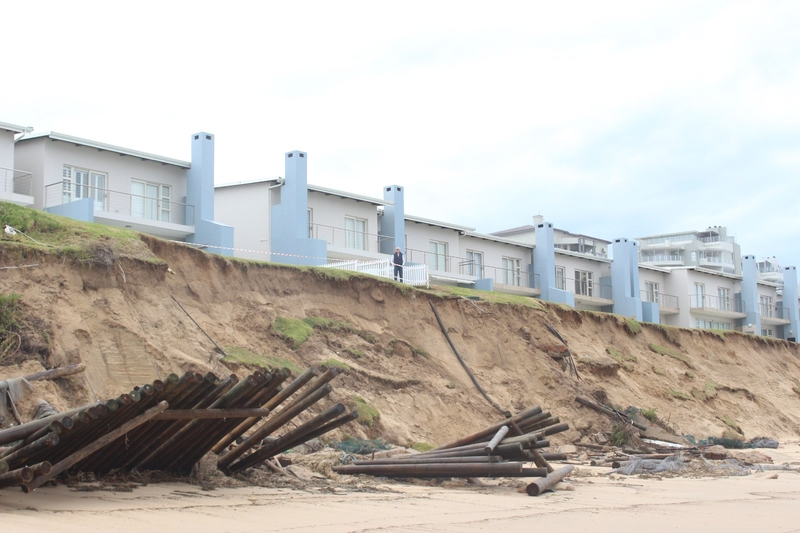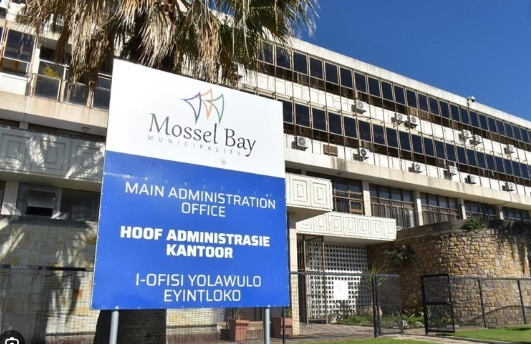
By conventional municipal standards, Mossel Bay Municipality presents itself as exceptionally functional.
The streets are maintained. Emergency response systems operate efficiently. Infrastructure teams perform admirably. Public spaces remain orderly and operational.
To residents and visitors alike, Mossel Bay projects the image of a municipality that works.
However, operational excellence alone does not guarantee long-term fiscal sustainability or sound institutional governance.
Increasingly, serious structural questions are emerging regarding whether Mossel Bay’s visible operational success is concealing deeper financial, governance, and sustainability risks beneath the surface.
The Operational Shield
A critical distinction must first be made.
The municipality’s front-line workers are not the problem.
The engineers, technical staff, water specialists, maintenance teams, electricians, emergency responders, and operational personnel deserve substantial recognition for maintaining service delivery under increasingly complex financial and infrastructure conditions.
In many respects, they are carrying the institution.
Their professionalism and efficiency have enabled Mossel Bay to maintain a strong public image despite mounting concerns surrounding:
· long-term infrastructure affordability
· reserve sustainability
· escalating fixed-cost recovery
· water security constraints
· and growing financial pressure on compliant ratepayers.
However, operational excellence can also create a strong perception of institutional health which unintentionally shields executive governance decisions from deeper public scrutiny.
The danger is not immediate collapse.
The danger is gradual structural distortion concealed beneath operational competence.
The Fiscal Warning Signs
Behind the municipality’s polished operational image, multiple financial stress indicators appear to be increasing simultaneously.
These include:
· growing bad debts
· expanding impairments and provisions
· rising affordability pressure on households and businesses
· increasing infrastructure funding obligations
· and expanding fixed-cost recovery mechanisms.
Individually, these indicators may appear manageable.
Collectively, however, they may signal growing structural financial pressure beneath the municipality’s visible operational success.
Particular concern exists regarding the increasing financial burden being placed on the shrinking base of compliant paying ratepayers.
Rather than aggressively resolving systemic losses, affordability failures, and long-term structural inefficiencies, the current trajectory increasingly appears dependent on extracting higher fixed revenue from those residents and businesses who continue paying consistently.
This creates a growing perception that compliant ratepayers are being asked to absorb the cost of broader structural expansion, inefficiency, and future infrastructure obligations.
The Fixed-Charge Controversy
Particular concern also exists regarding the increasing reliance on fixed electricity and municipal service charges.
This concern is not opposition to infrastructure funding itself.
Rather, the issue centres around transparency, fairness, and proper disclosure.
Many residents and businesses remain unclear regarding:
· what specific infrastructure obligations these fixed charges are funding
· whether the charges accurately reflect actual infrastructure maintenance requirements
· whether operational losses and inefficiencies are being embedded into permanent cost recovery structures
· and whether councillors and residents fully understood the long-term implications of these pricing models before approving them.
As fixed charges increase:
· efficient consumers face increasing financial penalties
· solar users remain trapped within municipal recovery structures
· and the true underlying cost drivers within the system become progressively more difficult to interrogate publicly.
Serious concern also exists regarding whether councillors themselves are consistently provided with sufficiently simplified, transparent, and technically reconciled information before voting on major tariff, infrastructure, land, and development-related matters.
Where highly technical financial structures become difficult to interrogate, democratic oversight weakens and executive influence correspondingly strengthens.
Water Security and Development Risk
Mossel Bay’s long-term water sustainability remains one of the municipality’s most critical strategic risks.
A fundamental distinction must be recognised:
Treatment capacity is not the same as sustainable raw water availability.
Operational staff can optimise purification systems and distribution infrastructure, but they cannot manufacture raw water yield.
Current concerns increasingly focus on:
· long-term dam sustainability
· reliance on favourable rainfall cycles
· the limitations of desalination support
· development sequencing
· and whether bulk water availability is genuinely keeping pace with aggressive urban expansion.
Desalination may provide supplementary support during periods of stress, but it introduces substantial energy dependency and significantly higher operational costs when compared to traditional bulk raw water supply.
The concern increasingly raised by residents is whether infrastructure expansion and development approvals are advancing faster than long-term sustainable water security can safely support.
Governance and Public Participation
Under sound municipal governance principles, operational performance must be matched by:
· sustainable reserve management
· transparent cost recovery
· prudent infrastructure sequencing
· meaningful public participation
· and accountable executive oversight.
Increasingly, residents and civic stakeholders are expressing concern that public participation within Mossel Bay appears procedural rather than genuinely collaborative.
Organised civic bodies continue experiencing difficulty obtaining:
· granular financial information
· reconciled technical data
· and clear responses to substantive governance concerns.
Technical questions are frequently met with fragmented disclosure, delayed engagement, or broad procedural responses rather than direct substantive clarification.
Documented correspondence from MossRates reflects repeated attempts to obtain basic governance and public accountability information from the municipality.
This matters because municipalities are not private corporations.
They are publicly funded institutions constitutionally obligated to remain accountable to the communities financing them.
Where engagement becomes managed rather than facilitated, public trust inevitably begins to deteriorate.
The Rise of Municipal-Linked Structures
Growing concern also exists regarding the increasing use of municipal-linked entities, non-profit companies (NPCs), and externalised operational structures associated with public infrastructure and development initiatives.
The concern is not necessarily the existence of such entities themselves.
The concern is whether these structures:
· reduce transparency
· fragment accountability
· complicate oversight
· obscure true cost allocation
· duplicate executive functions
· and weaken direct public scrutiny over ratepayer-funded activities.
As more operational and developmental functions move into partially externalised structures, visibility over public assets, funding flows, infrastructure obligations, and governance accountability can become increasingly difficult for ordinary residents to properly interrogate.
This creates the perception of a widening gap between operational presentation and public visibility into the underlying financial structure.
The Broader Structural Concern
The core issue facing Mossel Bay is not one isolated decision.
It is the cumulative pattern.
When evaluated collectively, the following trends begin intersecting simultaneously:
· rising bad debts and impairments
· escalating fixed-cost recovery
· increasing pressure on compliant ratepayers
· infrastructure expansion obligations
· long-term water security concerns
· reserve sustainability questions
· growing governance opacity
· weakened public participation
· and increasing complexity through externalised structures.
A municipality cannot indefinitely rely on operational excellence to compensate for weakening fiscal transparency and growing structural risk.
Eventually, the underlying financial reality surfaces.
Mossel Bay’s front-line workforce continues delivering impressive operational performance.
The question now is whether executive governance will demonstrate the same level of transparency, restraint, accountability, and long-term fiscal discipline required to preserve that success sustainably into the future.
Related
Discover more from MossRates
Subscribe to get the latest posts sent to your email.