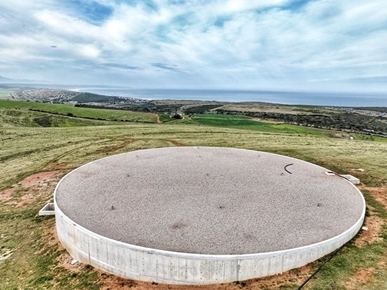
Mossel Bay Municipality has publicly stated that the new Vale Valley Reservoir forms part of its long-term bulk water infrastructure expansion strategy linked to future growth and development planning.
The Municipality has also referenced a future water delivery capacity of approximately 80ML/day.
Current municipal consumption, however, remains around ±26ML/day.
That raises a very important ratepayer question:
👉 Why is infrastructure being expanded to nearly 3 times current usage levels?
👉 And more importantly — who is paying for it?
MossRates again records that we are not opposed to sensible development, nor do we deny that Mossel Bay generally delivers good municipal services.
But responsible governance requires proper questioning of:
• timing;
• affordability;
• infrastructure sequencing;
• long-term sustainability;
• and who ultimately carries the financial burden.
Ratepayers are already facing:
• aggressive increases in fixed charges;
• substantial electricity and service cost escalation;
• rising property rates;
• and repeated annual tariff increases, including the latest proposed 5.8% increases.
At the same time, large-scale bulk infrastructure expansion continues.
This becomes especially relevant where:
• existing infrastructure was already sufficient for current residents;
• water security concerns remain unresolved;
• and long-term raw bulk water constraints are seldom openly discussed in public communication.
This is a critically important distinction.
There is a major difference between:
👉 water treatment and delivery capacity; and
👉 sustainable raw bulk water availability.
Infrastructure can pump and distribute large volumes of water — but that does not automatically mean the long-term raw water resource itself is secure or sustainably available during prolonged drought conditions.
MossRates has repeatedly raised concerns that the Municipality often highlights treatment and delivery capacity, while giving far less public attention to:
• raw water yield limitations;
• drought vulnerability;
• extractable dam storage realities;
• future abstraction constraints;
• and the financial risks associated with growth-driven infrastructure expansion.
The core concern is simple:
If bulk infrastructure is expanded years in advance of actual development levy recovery, then existing ratepayers effectively carry the upfront capital burden and long-term maintenance obligations of future growth.
Once the infrastructure is built, the money is already spent.
The financial obligation becomes permanently embedded into the municipal cost structure, which then contributes to:
• higher fixed charges;
• rising tariffs;
• increased maintenance obligations;
• and growing pressure on the existing ratepayer base.
This is particularly concerning in a town like Mossel Bay:
• with limited large-scale employment growth;
• a strong retirement and holiday-home economy;
• and an increasingly unaffordable cost structure for ordinary working residents.
A beautiful town and good service delivery alone cannot justify ignoring long-term affordability and sustainability risks.
MossRates therefore again calls for:
• a slower and more conservative infrastructure approach;
• far greater transparency around development levies collected versus infrastructure expenditure incurred;
• honest disclosure regarding long-term raw water constraints;
• and meaningful public engagement with ratepayers on the true financial implications of the current growth agenda.
Good governance is not anti-development.
Good governance simply asks:
👉 Who benefits?
👉 Who pays?
👉 And is the long-term model truly sustainable for ordinary ratepayers?
Related
Discover more from MossRates
Subscribe to get the latest posts sent to your email.